
























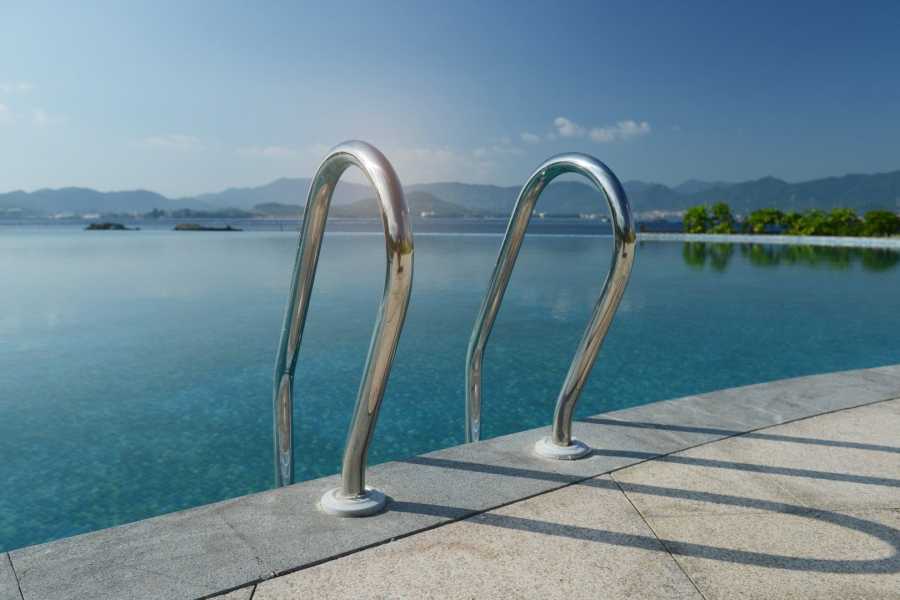
Pool for swimming located in the garden positioned over the underground parking area.
Pool construction above underground garages: importance of weight distribution
When installing a pool above areas with underground structures like garages, extra caution is necessary. The primary concern lies in the limited load capacity of the concrete floor slab and the significant water mass. Prior to installation, a structural engineer's assessment certifying the ability to withstand the expected weight is essential.
It's crucial to consider that every centimeter of water exerts a pressure of around 10 kg per 1 m². This implies that a pool with a depth of 50 cm applies approximately 500 kg/m² of pressure, while at 60 cm depth, the pressure rises to 600 kg/m². Most residential and garage floors are typically designed for loads of 200–400 kg/m². Thus, even a relatively shallow pool could surpass safe limits significantly.
Potential Hazards
The primary risk involves overloading the floor. Besides the static water weight, dynamic factors like people moving in the pool, jumping, and wave effects increase the load beyond the static weight.
Potential leaks pose another serious concern. If water breaches the waterproofing, it can reach the reinforced concrete, accelerating reinforcement corrosion due to constant exposure to moisture, chlorine, or saltwater. This corrosion weakens the floor over time, potentially leading to severe structural damage.
Legal Responsibility
Installing a pool without verifying the structure's load capacity can render the owner liable for any ensuing damage. In cases of floor damage or leaks affecting lower areas, the owner is accountable for reparations.
If the garage is part of an apartment complex or under a different owner, the repercussions could be more severe. Endangering human safety may result not only in civil liability but also criminal consequences. Moreover, many residential complexes prohibit adding extra loads to shared structures without proper authorization.
Hence, it's vital to not only seek an engineer's evaluation before installation but also understand the homeowners' association rules and notify the building management if necessary.
Safe Pool Installation Practices
To mitigate risks, adhering to several essential guidelines is recommended:
- Review the building's design plans to estimate the floor's load capacity;
- Engage a structural engineer to calculate the actual load and consider reinforcing the structure if needed;
- Position the pool where the load transfers to load-bearing elements - beams, columns, or walls, avoiding central ceiling sections;
- If full pool installation isn't feasible per calculations, explore alternatives like compact hot tubs or load-spreading platforms.
Pool Foundation Considerations
The pool base must be level and safeguard the bowl's bottom from harm.
Preferred options include extruded or foamed polystyrene slabs or foam material substrates with a protective PVC layer on top.
For uneven surfaces, creating a 2–3 cm leveling layer of river sand is advised. Avoid using regular polyethylene film as it's prone to damage.
Subfloor preparation varies based on the surface type:
- Lawn or soil: Level the area, remove debris, and add sand for a smooth surface, with a protective PVC mat for pool preservation.
- Concrete or paving slabs: Use soft pads like foam or neoprene to protect the pool material and enhance insulation.
Ideal Pool Location in the Garden
An open, sunlit area shielded from strong winds and distant from large trees is optimal for pool placement.
Consider these factors when selecting a spot:
- Lighting and greenery: Choose a south or southwest-facing spot for natural warmth and avoid tree proximity to prevent water contamination and pool damage.
- Convenience and safety: Ensure visibility from the house, especially for children. Provide easy access to water and electricity for equipment connections, with privacy considerations.
- Soil quality: Opt for a stable, non-sinking foundation with a level surface to prevent load distribution issues.
News